
Technology is becoming a bigger part of everyday healthcare, and senior rehabilitation is no exception.
For older adults, new technology can make it easier to monitor movement, stay connected with healthcare professionals, follow exercise programs, and receive support without having to travel frequently to a rehabilitation facility.
But technology does not mean replacing the human side of rehabilitation.
In fact, some of the most promising developments in senior rehabilitation are focused on using technology to support therapists, not replace them.
A 2026 review of geriatric Physical and Occupational Therapy highlights digital health, wearable sensors, and artificial intelligence as emerging opportunities for monitoring functional changes in real-world environments. At the same time, researchers emphasize the importance of clinical validation, accessibility, privacy, and appropriate human oversight.
For seniors in New York City, this creates an interesting opportunity: technology can complement personalized rehabilitation while allowing therapy to remain centered around the individual.
What Does Technology-Supported Rehabilitation Look Like?
Technology in rehabilitation can take many forms.
It does not necessarily mean complicated equipment or expensive devices.
Depending on the patient’s needs, technology-supported rehabilitation may include:
- Smartphone exercise applications
- Wearable activity trackers
- Movement-monitoring devices
- Video-based communication
- Remote therapeutic monitoring
- Digital exercise programs
- Smart home technology
- Electronic progress tracking
The appropriate technology depends on the individual.
A senior who is comfortable using a smartphone may benefit from a digital exercise reminder. Another person may benefit more from a simple wearable activity tracker.
The technology should serve the rehabilitation plan rather than become the focus of it.
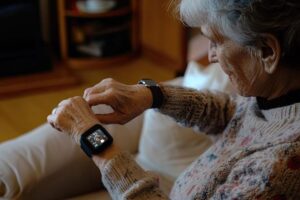
Wearable Devices Can Help Track Movement
Wearable devices are becoming increasingly common in healthcare.
Some devices can monitor physical activity, steps, heart rate, movement patterns, or other information.
For rehabilitation professionals, this type of information may eventually provide additional insight into what happens outside a therapy appointment.
That matters because a senior’s activity during a scheduled session may not represent their activity during the rest of the week.
A person might perform well for 45 minutes with a therapist but spend most of the following day sitting.
Technology can potentially help therapists understand those differences.
Current rehabilitation literature describes wearable sensors and digital technologies as opportunities to move beyond occasional clinic-based assessments toward more continuous monitoring of functional changes in everyday environments.
Remote Monitoring Can Support Home Exercise
Home exercise programs are often an important part of rehabilitation.
The challenge is consistency.
Older adults may forget an exercise, perform it differently than instructed, or become unsure whether they are progressing appropriately.
Remote monitoring technologies can provide another layer of support.
The U.S. Department of Health and Human Services notes that remote patient monitoring and remote therapeutic monitoring technologies can allow physical therapy-related information to be collected and shared with healthcare professionals, while some mobile applications can guide exercises and provide feedback.
Technology can therefore help extend communication beyond the traditional therapy appointment.
Technology Should Not Replace Personalized Care
This is one of the most important points for seniors and their families.
A digital exercise application cannot fully understand an older adult’s goals, home environment, medical history, confidence level, or changing abilities in the same way a qualified therapist can.
A wearable device can record activity, but it cannot independently determine why a person has stopped walking as much.
Perhaps the senior is experiencing pain.
Maybe they are tired.
Maybe they are afraid of falling.
Maybe transportation has become difficult.
Or perhaps they simply do not feel motivated.
Technology can provide information, but professional interpretation remains important.
Smart Homes and Aging in Place
Another growing area is smart home technology.
Research published in 2026 examined how technologies such as smart speakers, motion-activated lighting, doorbell cameras, and smart plugs may support older adults who want to remain at home. The research also identified barriers such as digital literacy, privacy concerns, maintenance, and cost.
For seniors, technology may potentially make certain parts of the home easier to navigate.
Motion-activated lighting may make nighttime movement easier.
Voice-controlled devices may reduce the need to reach for switches or phones.
Technology can also support communication with family members.
However, these tools should be selected carefully and should complement, rather than replace, appropriate rehabilitation and safety recommendations.
Why the Home Environment Matters
Technology becomes especially interesting when combined with in-home rehabilitation.
A therapist visiting a senior’s home can see how the person actually moves through their environment.
They can observe:
- How the person gets out of bed
- How they move through the kitchen
- How they stand from a chair
- How they navigate different rooms
- How they complete everyday activities
This information can then be considered alongside appropriate technology and rehabilitation strategies.
The result can be a more complete picture of the person’s everyday function.
Technology Can Help Families Stay Informed
Family members often want to know how an older loved one is progressing.
Depending on the rehabilitation program and technology being used, digital tools may make it easier to communicate information about exercise participation or activity levels.
However, privacy and consent should always be respected.
Technology should never become a source of pressure for the senior.
The purpose is to support rehabilitation, not make an older adult feel as though every movement is being monitored.
The Human Connection Still Matters
There is something technology cannot replace: human encouragement.
A therapist can recognize when a senior is frustrated.
They can adjust an activity when something is too difficult.
They can celebrate progress.
They can listen when a patient explains why a particular goal matters.
For many older adults, that relationship is an important part of rehabilitation.
The future of senior rehabilitation is therefore unlikely to be simply “technology versus traditional therapy.”
Instead, the opportunity is to combine useful technology with individualized professional care.
What This Means for Seniors in NYC
For older adults in New York City, technology-supported rehabilitation may offer additional ways to remain engaged with therapy while staying in a familiar environment.
At Rehab On Wheels, our approach begins with the individual.
Our Physical and Occupational Therapists provide personalized care designed around each patient’s abilities, goals, and everyday needs.
For seniors who have difficulty traveling, in-home Physical Therapy in NYC provides the convenience of receiving rehabilitation where daily activities actually take place.
Rehab On Wheels serves patients in Brooklyn and Staten Island, along with in-home rehabilitation throughout New York City.
Rehab On Wheels
174 Bay 29th St. Suite #C1
Brooklyn, NY 11214
Phone: 718-395-7445
Fax: 718-889-6707
Office Hours: Monday-Friday, 9 AM-5 PM
Therapy Hours: Monday-Sunday, 8 AM-8 PM
In Conclusion,
Technology is creating new possibilities for senior rehabilitation.
Wearable devices, remote monitoring, digital exercise programs, and smart home technologies may help therapists and families better understand how older adults function outside traditional appointments.
But technology works best when it supports personalized care.
For seniors, rehabilitation should remain focused on meaningful goals: moving safely, participating in daily activities, staying connected with others, and maintaining independence.
The future of senior rehabilitation in NYC may involve more technology, but the human relationship between therapist and patient will remain at the heart of effective care.
Author: Catherine Morrissey, PT, DPT