
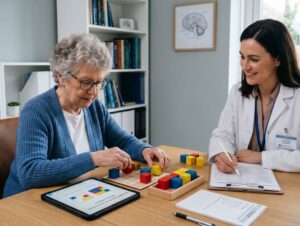
When an older adult receives a dementia diagnosis, families often focus on memory.
Will they remember appointments? Will they recognize familiar places? Will they be able to manage medications?
But dementia can affect much more than memory.
Over time, changes in attention, coordination, judgment, communication, and the ability to complete familiar activities can make everyday life more difficult.
This is where rehabilitation can play an important role.
A growing area of geriatric rehabilitation is person-centered, home-based therapy for people living with dementia. A September 2026 study examining the development of an at-home dementia rehabilitation program found support for an Occupational Therapy-led approach that emphasizes individualized goals, accessibility, empowerment, community engagement, and coordinated Physical Therapy support when mobility or exercise is needed.
For seniors in NYC, this approach is especially relevant because rehabilitation can take place in the environment where daily challenges actually occur.
Dementia Does Not Mean Rehabilitation Is No Longer Useful
There is a common misconception that someone living with dementia cannot benefit from rehabilitation.
That is not the case.
People living with dementia can continue to have physical abilities, preferences, routines, interests, and meaningful goals.
Rehabilitation can focus on preserving those abilities for as long as possible.
The objective may not always be to restore a previous level of function. Sometimes the goal is to help a person continue participating in familiar activities safely and comfortably.
That might mean:
- Getting dressed with less assistance
- Moving around the home more safely
- Participating in meal preparation
- Continuing a favorite hobby
- Walking around the neighborhood
- Maintaining personal care routines
- Remaining involved with family
- Continuing to live at home
These goals can be deeply meaningful to both the senior and their family.
Why Familiar Surroundings Matter
A clinic can provide a controlled environment for rehabilitation.
But home is where the person’s actual life takes place.
A senior living with dementia may have difficulty navigating a particular hallway, locating an item in the kitchen, remembering the steps of a familiar task, or transitioning between rooms.
An in-home therapist can observe those challenges directly.
That makes it possible to build rehabilitation around the person’s real environment instead of relying exclusively on exercises performed in a clinic.
Recent research specifically exploring at-home dementia rehabilitation identified the home environment as an important setting for maintaining independence and well-being.
Occupational Therapy Can Focus on Meaningful Activities
Occupational Therapy can be particularly valuable for seniors living with dementia because it focuses on participation in everyday activities.
Rather than asking only, “What physical limitation does this person have?” an Occupational Therapist may also ask:
“What does this person need and want to be able to do?”
That difference matters.
Perhaps a senior enjoys making coffee every morning.
Maybe they like folding laundry.
Perhaps they want to continue feeding themselves or choosing their clothes.
These activities can become rehabilitation opportunities.
The therapist can look at what makes the task difficult and determine whether changes to the activity, environment, routine, or level of assistance may help.
Physical Therapy Can Support Movement and Function
Physical Therapy can complement Occupational Therapy when dementia is accompanied by physical changes.
A Physical Therapist may address:
- Strength
- Walking ability
- Functional mobility
- Endurance
- Transfers
- Joint movement
- Physical activity
- Appropriate use of mobility equipment
The exercises should be adapted to the person’s cognitive and physical abilities.
Simple, familiar movements may sometimes be easier to follow than complicated instructions.
Consistency can also be valuable.
Rehabilitation Should Be Person-Centered
There is no single rehabilitation program for every person living with dementia.
Two seniors with the same diagnosis may have very different abilities, personalities, routines, and goals.
One person may respond well to verbal instructions.
Another may benefit more from demonstration.
Someone else may perform a task more successfully when it is incorporated into a familiar daily routine.
Person-centered rehabilitation takes these differences seriously.
The goal is to adapt therapy to the person rather than expecting the person to fit a rigid therapy program.
Repetition Can Support Familiar Routines
Familiar routines can be valuable for people living with dementia.
A rehabilitation strategy may incorporate activities into an established part of the person’s day.
For example, movement exercises might be connected with a morning routine.
- Walking practice might be incorporated into a normal trip between rooms.
- An everyday task might be practiced repeatedly in the same location.
- The exact approach depends on the person’s abilities and therapist’s recommendations.
The objective is to make rehabilitation feel relevant rather than disconnected from daily life.
Families Can Be Part of the Rehabilitation Team
Family members often know the senior’s routines better than anyone else.
They know what activities the person enjoys.
They may recognize when the senior is frustrated, tired, confused, or comfortable.
That information can help therapists create more individualized treatment.
At the same time, caregivers should not be expected to become rehabilitation professionals.
The therapist can explain how family members can provide appropriate support while respecting the senior’s abilities and independence.
Recent rehabilitation research also emphasizes the importance of coordinated care involving people with dementia, care partners, and healthcare professionals.
Maintaining Community Connection Matters
Dementia rehabilitation should not stop at the front door.
Remaining connected to other people can be an important part of quality of life.
If a senior enjoys attending religious services, visiting friends, going to a senior center, or spending time with family, rehabilitation can consider the physical abilities required to continue participating.
This might involve improving endurance, practicing transfers, or developing strategies for navigating everyday environments.
The larger goal is participation in life, not simply completion of exercises.
When Should a Family Consider Rehabilitation?
Families may want to discuss rehabilitation when they notice that dementia is accompanied by changes in physical or daily function.
Examples include:
- Difficulty getting dressed
- Increasing assistance with personal care
- Changes in walking
- Difficulty completing familiar household activities
- Reduced participation in hobbies
- Trouble getting in and out of chairs
- Increased difficulty navigating the home
- Reduced confidence with everyday movement
A healthcare professional can help determine whether Physical Therapy, Occupational Therapy, or another service is appropriate.
In-Home Dementia Rehabilitation in NYC
At Rehab On Wheels, we believe rehabilitation should reflect the person receiving care.
Our Physical and Occupational Therapy services are designed around individual abilities, functional goals, and everyday routines.
For seniors living with dementia, the home can provide an important setting for meaningful rehabilitation because therapists can work within the environment the person knows best.
Rehab On Wheels provides therapy in Brooklyn and Staten Island, along with in-home rehabilitation throughout New York City.
For families seeking in-home Physical Therapy or Occupational Therapy in NYC, personalized care can help older adults work toward maintaining function, participation, and independence.
Rehab On Wheels
174 Bay 29th St. Suite #C1
Brooklyn, NY 11214
Phone: 718-395-7445
Fax: 718-889-6707
Office Hours: Monday-Friday, 9 AM-5 PM
Therapy Hours: Monday-Sunday, 8 AM-8 PM
Conclusion
Dementia changes many aspects of life, but it does not erase a person’s need for independence, meaningful activity, connection, and dignity.
Rehabilitation can help families look beyond memory loss and consider the person’s physical abilities, routines, environment, and personal goals.
With individualized Physical and Occupational Therapy, seniors living with dementia may be able to continue participating in activities that give structure and meaning to their days.
For families in Brooklyn, Staten Island, and throughout NYC, in-home rehabilitation can bring that support directly into the environment where the person lives.
Author: Catherine Morrissey, PT, DPT