Rehabilitation is often associated with physical goals.
- Walking farther.
- Getting stronger.
- Improving flexibility.
- Moving more comfortably.
But for an older adult, physical function is only one part of living a fulfilling life.
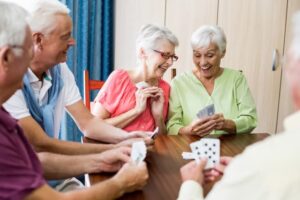
Being able to leave the house, visit family, attend community activities, meet friends, participate in hobbies, or simply spend time around other people can be just as meaningful.
That is why social participation is becoming an increasingly important part of the conversation around healthy aging and rehabilitation.
A 2026 systematic review of 85 randomized controlled trials found that community-based interventions addressing physical activity, cognitive support, nutrition, social engagement, and rehabilitation were generally associated with improvements in independence-related outcomes, including functional ability, mental well-being, and social participation.
Another 2026 study found that a community rehabilitation model combining physical activity with intentional social participation was associated with improvements in functional mobility, muscular strength, life satisfaction, and loneliness.
For seniors, this suggests that rehabilitation should not always be measured by physical performance alone.
Why Social Participation Matters as We Age
People naturally have different levels of social activity.
Some older adults enjoy busy social calendars.
Others prefer a quiet routine with a few close relationships.
The goal is not to make every senior highly social.
The goal is to help older adults maintain the ability to participate in the activities and relationships that matter to them.
For some, that may mean:
- Visiting family
- Attending community events
- Going to a senior center
- Shopping independently
- Walking around the neighborhood
- Participating in hobbies
- Attending religious or cultural activities
- Meeting friends for coffee
- Spending time outdoors
Physical limitations can gradually make these activities harder.
That is where rehabilitation can help.
When Physical Limitations Start Shrinking Someone’s World
Consider an older adult who begins experiencing difficulty walking.
At first, they stop taking longer walks.
Then they stop going to the store.
Eventually, they may avoid visiting friends because leaving the house feels like too much work.
The original physical problem may have started as a mobility issue. But the consequences can become much broader. The person’s daily routine becomes smaller.
They have fewer opportunities to interact with others. They may become less physically active. And reduced activity can make physical limitations even more difficult to manage.
This is why rehabilitation should consider the activities a senior wants to return to, not only the physical impairment itself.
Rehabilitation Goals Can Be Social Goals
A senior may tell a therapist:
“I want to walk to my granddaughter’s school.”
“I want to go shopping with my daughter.”
“I want to return to my weekly community group.”
“I want to be able to visit my friends again.”
These are rehabilitation goals.
They may sound different from traditional clinical goals, but they are connected to physical function.
A therapist can work backward from the desired activity.
What physical abilities are required?
How far does the person need to walk?
How long will they need to stand?
Will they need to get in and out of a vehicle?
Can they manage the environment safely?
What level of endurance is needed?
These questions help turn meaningful life activities into practical rehabilitation targets.
Physical Therapy Can Help Build Community Mobility
Community mobility involves much more than walking across a living room.
A senior may need to walk longer distances, navigate uneven sidewalks, stand while waiting, manage doors, change direction, or move through crowded environments.
Depending on the individual’s needs, Physical Therapy can work on the physical abilities required for these activities.
This may include:
- Strength
- Endurance
- Walking tolerance
- Functional mobility
- Coordination
- Movement efficiency
- Transfers
- Appropriate use of mobility devices
The goal is to help the person participate in the environments that matter to them.
Occupational Therapy Can Help Seniors Reconnect With Activities
Occupational Therapy takes a broader look at participation.
If a senior wants to return to a favorite hobby, community activity, or household responsibility, an Occupational Therapist can examine what is preventing participation.
Perhaps the activity requires too much standing.
Maybe certain objects are difficult to handle.
Perhaps the environment is difficult to navigate.
Maybe the person needs a different strategy for completing the activity.
Occupational Therapy can help identify practical adaptations that may make participation more manageable.
Social Engagement Can Make Physical Activity More Meaningful
Exercise can feel like a chore when it has no connection to a person’s interests.
But movement can become more meaningful when it is connected to something the person enjoys.
Walking to meet a friend is different from walking simply because someone says they should walk.
Standing while preparing a meal with family can feel more purposeful than performing an isolated standing exercise.
Going outdoors can provide both physical activity and social interaction.
This does not mean every rehabilitation session needs to become a social activity.
It means therapy can consider what motivates the individual.
In-Home Therapy Can Help Bridge the Gap
For some seniors, the biggest obstacle to participation is getting started.
Leaving home may feel difficult because of weakness, limited endurance, transportation concerns, or uncertainty about movement.
In-home Physical Therapy can address some of the physical barriers within the person’s own environment.
A therapist can work on practical movements that eventually support broader participation outside the home.
For example, therapy may begin with moving safely from one room to another and gradually progress toward greater walking tolerance or community-based goals, depending on the person’s abilities.
Families Can Help Encourage Participation
Family members can play a supportive role by learning what activities matter most to the senior.
Instead of focusing exclusively on what the person cannot do, families can ask:
“What would you like to be able to do again?”
That answer can provide valuable direction.
Maybe it is going to a family dinner.
Maybe it is attending a favorite community event.
Maybe it is simply being able to walk outside and sit on a bench.
A rehabilitation plan built around meaningful goals may feel more motivating than one based entirely on numbers and repetitions.
Social Participation and Aging in Place
Aging in place is not simply about remaining inside a home.
It is about being able to live meaningfully within the home and community.
Current geriatric rehabilitation literature increasingly frames healthy aging around function, participation, well-being, and the ability to remain engaged within one’s environment.
That means rehabilitation can consider not only whether someone can move from point A to point B, but why they want to get there. That “why” can be powerful.
When Social Withdrawal May Signal a Functional Problem
Not every reduction in social activity is caused by physical limitations.
Older adults may withdraw because of grief, depression, anxiety, transportation problems, financial concerns, hearing difficulties, cognitive changes, or many other reasons.
But if a senior says they have stopped seeing people because they are afraid they cannot walk far enough, stand long enough, or manage the physical demands of an outing, rehabilitation may be worth discussing.
A healthcare professional can help determine what type of support is appropriate.
Supporting Active Aging in NYC
At Rehab On Wheels, we believe rehabilitation should connect with the life a person wants to live.
Our Physical and Occupational Therapy services are personalized around each senior’s abilities and goals.
For some patients, that may mean working toward greater independence at home.
For others, it may mean building the physical capacity needed to participate more fully in family, community, and social activities.
We serve older adults in Brooklyn and Staten Island, as well as providing in-home rehabilitation throughout New York City.
For seniors who have difficulty traveling, in-home therapy allows rehabilitation to begin in a familiar environment and progress toward meaningful real-world goals.
Rehab On Wheels
174 Bay 29th St. Suite #C1
Brooklyn, NY 11214
Phone: 718-395-7445
Fax: 718-889-6707
Office Hours: Monday-Friday, 9 AM-5 PM
Therapy Hours: Monday-Sunday, 8 AM-8 PM
Conclusion
Senior rehabilitation is about more than strength, walking, or physical measurements.
It is also about participation.
An older adult may want to regain physical ability not simply to exercise, but to see a friend, attend an event, visit family, enjoy a hobby, or remain connected to the community.
That is why meaningful rehabilitation goals should reflect the whole person.
For seniors in NYC, personalized Physical and Occupational Therapy can help address physical limitations while keeping the activities and relationships that matter most at the center of care.
Author: Catherine Morrissey, PT, DPT